


Handball throwing power training: The complete guide for more power, technique & throwing speed
Introduction
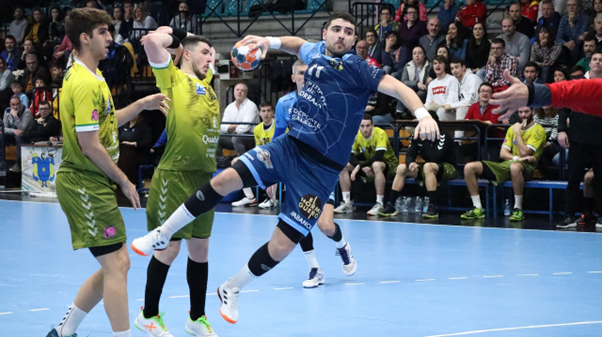
A powerful throw in handball is more than just a simple movement – it's often the key to scoring. Every player knows the moment: the ball is perfectly positioned in their hand, their eyes are on the goal, and in a fraction of a second, the power of the throw determines victory or defeat. A quick, explosive throw can surprise the goalkeeper and give their team the decisive advantage.
But many ask themselves: How can you train throwing power and systematically increase handball throwing speed? Is it enough to build more strength in the arms, or is a holistic approach needed? The answer lies precisely here: A powerful throw is not only based on muscle strength in the arm, but on an interplay of three key pillars – strength, technique, and explosiveness.
This guide explains why handball throwing is a full-body movement, which exercises will help you improve your throwing power, and how you can effectively convert your strength into speed. We also present specific handball throwing drills that you can immediately integrate into your training. Whether you're wondering "How fast do handball players throw?" or how you can increase your own handball throwing speed – you'll find the answers here.
The basic principle: Why throwing power in handball is a whole-body movement
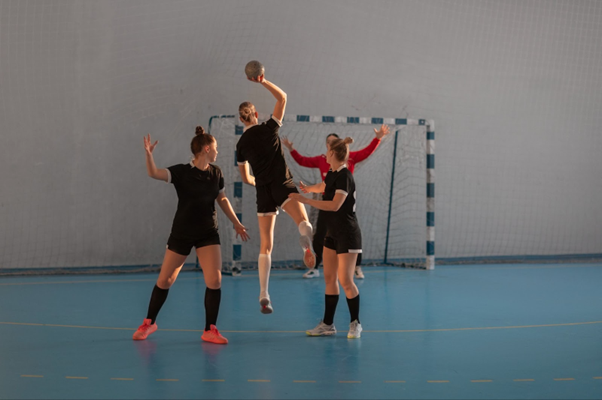
When you ask handball players about their throwing power, you often hear: "I need stronger arms." But this view is too simplistic. A handball throw is not an isolated arm movement – it's a complex chain of movements that involves the entire body.
The force originates in the lower body, is transmitted through the torso, and finally transferred to the ball via the arm and hand. This principle of the kinetic chain is crucial for improving throwing power.
- Legs: They are the foundation. A stable stance, powerful jumps, and a dynamic approach provide the initial energy. Without strong legs, maximum handball throwing speed cannot be achieved.
- Core: The core acts like a transmission belt. It connects leg movement to the upper body and ensures that the generated energy is not lost. Weak core muscles lead to energy loss and unstable throws.
- Shoulders and arms: They ultimately release the ball. This is where the explosiveness and precision of the throw are determined. The arm is therefore not the source, but the final link in the chain.
Studies show that professional handball players don't achieve their throwing speed through arm strength alone, but through perfect timing of the entire muscle chain. That's why it's so important not to rely solely on weight training when working on throwing power, but to harmonize the legs, core, and upper body.
Understanding that a handball throw is a full-body movement lays the foundation for long-term success. Only when all body parts work together does the explosive dynamic arise that enables a truly fast and powerful throw.
Pillar 1: The right strength training for an explosive shoulder and a strong core
Anyone wanting to improve their throwing power needs a well-structured strength training program. Many players believe that strengthening their arms is enough to increase their handball throwing speed. In reality, handball strength training is a holistic process. Only by training the shoulders, core, triceps, and legs equally can throwing power be improved.
Why targeted strength training is crucial
A handball throw is an extremely dynamic movement that puts stress on the body within milliseconds. Without strong muscles, joints like the shoulder or elbow can quickly become overloaded. Systematic strength training improves:
- Shoulders more resistant to injury.
- The hull/core is more stable, resulting in better energy transfer.
- Legs become more explosive, which translates directly into higher throwing speed in handball during jump shots.
Overview of important muscle groups
- Shoulders (deltoid, rotator cuff): Stability and control during the backswing and release.
- Trunk/Core (abdominal and back muscles): Connecting link between lower and upper body, crucial for balance and stability.
- Triceps and pectoral muscles: Maximum acceleration in the final release.
- Legs (quadriceps, hamstrings, calves, glutes): Explosive push-off during the jump shot, foundation of the entire movement.
Effective exercises for increased throwing power
- Medicine Ball Throws
- Various options (overhead, sideways, against the wall).
- Train explosiveness and transfer of core power.
2. Push-ups and variations
- Classic, one-armed, or with shoulder clapping.
- Strengthen chest, arms and core simultaneously.
3. Core Training
- Planks, side planks, Russian twists.
- They promote stability and prevent energy loss.
4. Resistance Band Workouts
- External rotations and shoulder stabilization.
- Especially important for injury prevention.
Lower body exercises
- Squats, lunges, box jumps.
- Basis for jumping power and whole body stability.
Training note
The goal is not to build bodybuilder-like muscles, but functional strength that can be directly transferred to handball throwing technique. A structured program with 2-3 sessions per week is ideal for improving throwing power in the long term.
Pillar 2: The perfect throwing technique – How to use your power optimally
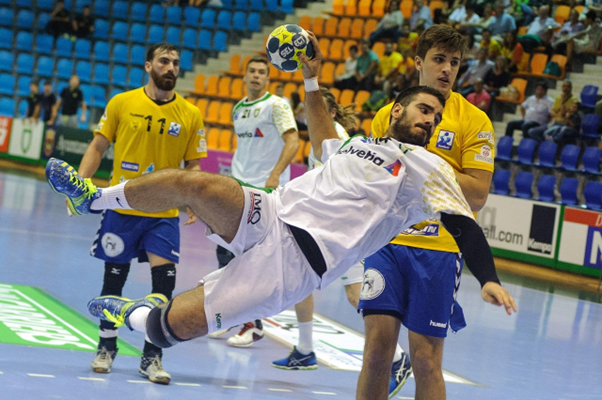
Even the greatest muscle strength is of little use if the throwing technique in handball is incorrect. A clean technique allows all the energy from the legs and core to be transferred into the ball, thus maximizing handball throwing speed.
Why technology is so crucial
Poor technique often leads to energy loss, inaccurate throws, or even injuries. Correct technique, on the other hand, allows you to improve your throwing power and achieve greater effect with less effort.
Step-by-step: The correct throwing technique
- Run-up (3-step rule)
- The run-up provides momentum and prepares the body for the explosive movement.
- Three dynamic steps are standard for building rhythm and timing.
2. Body tension and posture
- Core tense, eyes fixed on the goal.
- The supporting leg provides stability, the free leg provides dynamism.
3. Arm position
- Elbow at shoulder height, throwing arm slightly tilted backward.
- The shoulder remains stable to avoid injury.
4. Rotation of the upper body
- The torso rotates explosively forward, transferring the force to the arm.
5. Follow-Through
- Actively snap your wrist forward.
- Important for precision, spin and additional speed.
Common mistakes in throwing technique
- Insufficient core tension → energy is lost.
- Incorrect arm posture → shoulder strain and reduced precision.
- Lack of follow-through → The ball loses speed.
Practical tip
Video recordings of your own throw or feedback from the coach help to identify technical errors early on. Often, small corrections are enough to increase handball throwing speed by several km/h.
Those who consistently work on their technique combine power and precision – and thus develop throws that are not only fast, but also difficult for the goalkeeper to predict.
Pillar 3: Explosive Power and Throwing Speed – How to Convert Your Strength into Speed
Many players focus on building muscle when training their throwing power. But strength alone isn't enough – the ability to access that power in a very short time makes all the difference. This is precisely where explosive power comes into play. It determines how explosive a movement is and ultimately how high the handball throwing speed will be.
What is explosive power in handball?
Explosive power means generating maximum force within milliseconds. In handball, this is crucial, as throws must be not only powerful but also lightning-fast to surprise the goalkeeper. Training your explosive power allows you to improve your throwing power and use it more effectively.
A player with high explosive power can:
- Throws at a significantly higher speed.
- React faster to game situations.
- Jump explosively at crucial moments and release the ball with maximum energy.
Plyometric training as a key
Plyometric exercises are specifically designed to increase throwing speed in handball. They train muscles and the nervous system to make movements more explosive. Typical exercises include:
- Box Jumps
- Explosive jump onto a raised platform.
- It trains jumping power and leg muscles – crucial for the jump throw.
2. Clapping Push-ups
- Classic push-ups where you push off so explosively that a clapping sound is possible.
- Promotes arm and chest explosiveness, improves the final phase of the throw.
3. Medicine Ball Slams
- Hit the medicine ball on the floor with full force.
- A full-body exercise for the torso, shoulders and arms, ideal for increasing throwing power.
4. Jump Variations
- One-legged jumps, squat jumps, or side jumps.
- Improve agility, coordination, and explosive power simultaneously.
Training tips for more explosiveness
- Short intervals, maximum intensity: In explosive strength exercises, quality trumps quantity. Five explosive repetitions are better than 20 slow ones.
- Schedule breaks: The body needs time to regain full explosiveness. There should be a 60-90 second break between sets.
- Combination with technical training: Explosive strength exercises have the greatest effect when they are directly combined with handball throwing technique exercises – e.g. box jumps plus jump throws.
Common mistakes in explosive strength training
- Too many repetitions → loss of explosiveness.
- Incorrect execution → increased risk of injury.
- Lack of variety → training effects stagnate.
Those who regularly work on their explosive power will notice that their handball throwing speed not only measurably increases, but their reaction time during the game also improves significantly. This results in a truly explosive, almost unstoppable handball throw, built from raw power.
Specific handball throwing technique exercises for your training
Exercise 1: Knee throw with medicine ball
- Tense core, throw medicine ball explosively forward.
- Goal: To train the upper body in isolation and improve throwing power.
Exercise 2: Wall Throws
- Repeated throws against the wall, focus on speed and technique.
- Trains handball throwing speed and ball control.
Exercise 3: Distance throws to a partner
- Long throw across the full length of the hall.
- Promotes the transfer of power from the lower body to the ball for an effective handball throw.
Exercise 4: One-legged jump throws
- Jumping on one leg, throwing while jumping.
- It trains balance, coordination, and explosiveness.
Exercise 5: Target throws at different heights
- Variable throw against cones or goals.
- Promotes precision with maximum throwing power in handball.
Don't forget: Regeneration and stretching for injury prevention
Many players focus almost exclusively on training throwing power, building strength, and increasing handball throwing speed. However, without sufficient recovery, the risk of injury increases significantly. Especially in handball, where the shoulder and arm joints are subjected to considerable stress, prevention is essential.
Why regeneration is so important
During intense training sessions, tiny micro-tears occur in the muscles. These heal optimally only if the body is given sufficient recovery time. A well-planned regeneration process helps:
- To prevent injuries, especially overuse injuries to the shoulder and elbow.
- To improve throwing power, since muscles only grow and become stronger through rest.
- Maintaining a consistently high throwing speed in handball, even with multiple training sessions per week.
Practical tips for optimal regeneration
- Cooldown: After each training session, a phase of light running, gentle stretching, and relaxed ball handling should be planned.
- Stretching routines: Specific stretching exercises for the shoulders, chest and back improve mobility and prevent stiffness.
- Fascia training: A fascia roller can be used to release adhesions in muscle structures that would otherwise restrict freedom of movement when throwing handball.
- Sleep: Sufficient and restful sleep is one of the biggest factors for improving performance.
Effective stretching exercises after handball training
- Shoulder stretch across the back: Pull your arm in front of your chest to loosen the back of your shoulder.
- Triceps stretch overhead: Bring your arm behind your head to stretch the extensor muscles of the arm.
- Chest stretch against the wall: Place one hand against the wall, twist your body slightly to open up your chest muscles.
- Cat-Cow and Cobra-Stretch: Promotes flexibility in the torso and relieves the spine.
Those who regularly perform these routines not only improve their throwing power in handball, but also ensure a longer and injury-free career.
Conclusion
A powerful and fast handball throw is not a matter of chance, but the result of consistent work on three pillars: strength, technique, and explosiveness. Anyone wanting to train their throwing power must understand that the entire body – legs, core, shoulders, and arms – must work together harmoniously.
Through targeted strength training for the most important muscle groups, proper throwing technique in handball, and exercises to develop explosive power, every player can improve their throwing power and significantly increase their throwing speed. Regular handball throwing technique drills also ensure better ball control, greater precision, and more confidence during play.
But it's equally important not to neglect regeneration. Stretching, fascia work, and recovery phases are the foundation for staying healthy in the long term and continuously improving performance. Only in this way can players maintain their throwing speed in handball over many years.
Key takeaways:
- Strength training: Focus on shoulders, core, triceps and legs.
- Optimize throwing technique: 3-step approach, body tension, follow-through.
- Build explosive power: Plyometric exercises such as box jumps or clapping push-ups.
- Pay attention to regeneration: stretching, cooldown, sleep and mobilization.
- Long-term focus: A fast, powerful handball throw doesn't happen overnight, but through consistent training.
👉 If you want to train your throwing power and sustainably increase your handball throwing speed, start now with the exercises presented and integrate them regularly into your training. This way you will gradually develop the strength, technique and explosiveness that will make you an even better player.
Related Posts

Handball training for children

Handball Rules: A brief overview of the most important rules of the game


