


Basketball Rules: The most important information about the rules of the game
Basketball is one of the world's most popular sports, captivating millions of fans, both as spectators and players. Understanding the rules of this sport is essential for anyone who wants to play or fully appreciate the game's complexity. The basketball rules not only help improve your game but also avoid common mistakes that can influence the course of a match. It's important to note that there are different rule sets, such as those of FIBA (Fédération Internationale de Basketball) or the NBA, which can vary depending on the league.
The basic rules of basketball
How does the game begin?
A basketball game begins with a jump ball in the middle of the court. The referee throws the ball into the air between two players from each team, who attempt to tip it to a teammate to gain first possession. The basket each team must defend is usually determined before the game begins. In the NBA, the team that wins the jump ball receives first possession in the fourth quarter. The second and third quarters begin with possession for the opposing team.
How many players are there in basketball?
How many players are there in basketball? Each team has five players on the court at any one time. However, unlimited substitutions are allowed when the game is stopped. This allows coaches to adjust their team's strategy as needed, for example, to give players a break or to neutralize an opposing player.
Living and dead ball
The ball is considered "live" once it is in play, that is, from the moment it is touched by a player after a jump ball or throw-in. It is considered "dead" when the referee stops play due to a foul, a rule violation, or a scored basket.
Points in basketball
Points can be scored in basketball in various ways. A free throw (a shot awarded after a foul) is worth 1 point, a shot inside the three-point line is worth 2 points, and a successful shot outside the line is worth 3 points.
It is possible to accumulate points in certain situations. A foul on a player attempting a two-point shot results in two free throws if the shot misses. If the shot is successful, the team receives 2 points and an additional free throw. Players can score 2+1 points. This principle also applies to three-point shots.
The positions in basketball
In basketball, there are five main positions on the court, each with specific roles and responsibilities. Here is a description of each position:
Point Guard (PG)
The point guard, often referred to as the "brain" of the team, is the player who directs the game. He is responsible for organizing offensive plays and controlling the pace of the game. The point guard is typically an excellent dribbler and passer, with exceptional court vision to put his teammates in the best possible positions. He must also be able to score, but his priority is to get the team involved in the game.
Key attributes: speed, court vision, dribbling, ability to organize the game.
Examples: Stephen Curry, Chris Paul.
Shooting Guard (SG)
The shooting guard is often the team's best shooter. His primary role is to score points, especially from mid-range or the three-point line. Besides shooting ability, he must also be able to penetrate the opponent's defense to drive to the basket. Some shooting guards are also very good defensively and can contain the opponent's top scorers.
Key characteristics: ability to score or defend, speed.
Examples: Michael Jordan, Evan Fournier.
Small Forward (SF)
The small forward is often considered the most versatile player on the court. They must be able to score in various ways (long-range shot, drives to the basket) while also playing strong defense. Small forwards need to be athletic, agile, and able to play both inside and outside the basket, making them key players on both offense and defense.
Key characteristics: versatility, offensive and defensive skills, athleticism.
Examples: LeBron James, Kevin Durant.
Power Forward (PF)
The power forward is often one of the physically strongest players on the court. They play near the basket and are responsible for grabbing rebounds, defending in the paint, and scoring from short to mid-range. Traditionally, this was a position for powerful players, but increasingly, modern power forwards are also capable of hitting three-pointers, making their game more versatile.
Key characteristics: Physical strength, rebounding, ability to play near the basket.
Examples: Giannis Antetokounmpo, Guershon Yabusele.
Center (C)
The center is often the tallest and most imposing player on the team. He plays near the basket, both offensively and defensively. His role is to defend the paint by blocking shots and preventing the opponent from driving in. Offensively, he must score near the basket and grab offensive rebounds to give his team second chances. The center is also an important defensive anchor.
Key characteristics: size, strength, ability to grab rebounds, and paint defense.
Examples: Rudy Gobert, Nikola Jokic.
How do you play good basketball?
Basic Elements of the Game:
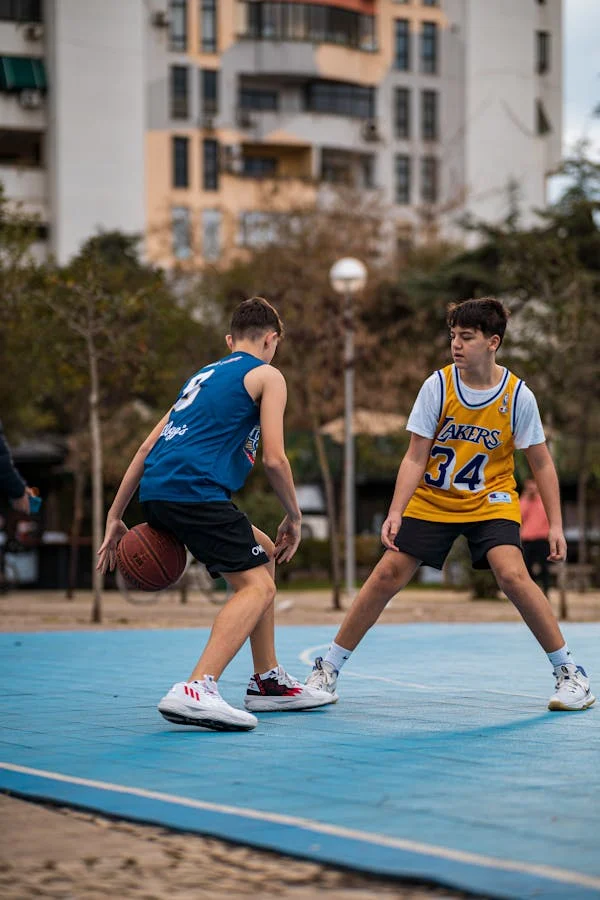
The key elements of the game include dribbling, shooting, and passing. When dribbling, a player must bounce the ball on the ground while moving; they may not take more than two steps without dribbling, otherwise they will be penalized for traveling. Furthermore, a player may not dribble again after stopping a dribble (double dribble).
What is allowed and what is not?
It's important to know what is and isn't allowed. Beginners often make mistakes by engaging in excessive physical contact with an opponent (personal foul) or violating movement rules (traveling, double dribbling).
The foul system in basketball is very strict, but it's crucial to understand that a defending player may not touch an attacking player with their hands. If the defender wants to stop the attack, they must touch the ball, not the player.
Important game situations
Alternating possession
In a disputed possession situation (the ball is held by two opposing players simultaneously), the referee awards a new jump ball. Possession at the start of each quarter alternates according to the alternating possession rule. This rule states that the team that wins the first jump ball has the throw-in in the fourth quarter, while the other team has the throw-in in the second and third quarters.
Basketball rules for offense and defense
On offense, the primary objective is to score points by throwing the ball into the opponent's basket. The offensive team has 24 seconds to attempt a shot. If the time expires, possession of the ball changes to the opposing team.
If the offensive team secures a rebound after a missed shot, they have another 24 seconds to attempt a shot (14 seconds in the NBA).
On defense, the goal is to prevent the opponent from scoring by intercepting the ball or blocking shots. However, it is illegal to block a shot when the ball is already moving downwards towards the basket (goal-ending). It is also illegal to defend the ball with your feet.

Fouls and violations
Types of fouls
Fouls include personal fouls (illegal physical contact). Personal fouls are common in a game and are a normal part of play. Unsportsmanlike fouls (violent or intentional acts) often result in ejection. Technical fouls (violations of basketball conduct rules or disrespectful behavior towards the referee or opponent) automatically result in ejection after a second technical foul. Depending on the severity of the foul, the opposing team may be awarded free throws or possession of the ball.
Steps and double dribbling
Walking is a violation when a player takes more than two steps without dribbling. (Three steps are allowed in the NBA.) Double dribbling occurs when a player stops dribbling and then resumes it. Both of these violations result in a turnover.
Specific rules
A team must always have at least five players on the court to continue playing. If a team has fewer than five players for any reason (fouls or injuries), it is forfeited.
In the NBA, there are a maximum of seven timeouts per team, and no more than two timeouts per team in the last three minutes of play. Timeouts are used to interrupt the flow of the game and reorganize the offense.
In the NBA, each team also has a challenge. A challenge allows a team to dispute a referee's decision during a game. If the team is successful, it gets its challenge back. However, a team can only use its challenge a maximum of two times per game.
Basketball is such a fast-paced game that referees sometimes cannot see certain plays in detail. Referees can make mistakes, and challenges help to mitigate these potential errors.
Tips for basketball beginners
For beginners, it's crucial to memorize the basic rules, such as dribbling, footwork, and fouls.
While basketball is a highly technical sport, it primarily demands good physical fitness. It's recommended to initially focus on improving your physical condition, as coaches expect players to contribute on defense and rebounds. This also allows for mobility on the court, increasing scoring opportunities.
Of course, dribbling and shooting techniques shouldn't be neglected. These will come with time, through 3-on-3 or 1-on-1 games and individual practice. Every player will tell you the importance of avoiding common mistakes, such as failing to dribble or committing contact fouls. The coach won't hesitate to bench you for these errors.
Here you will find our basketball product range.
Conclusion
Basketball, as both a technical and physical sport, requires a solid understanding of the rules to play effectively and avoid mistakes. Whether you're a beginner or an experienced player, mastering the fundamentals of the game, positions, rules, and offensive and defensive tactics is crucial for progress on the court. Beyond knowing the rules, developing physical and technical skills like dribbling, shooting, and defense is essential to becoming a well-rounded player.
Ultimately, basketball is a team sport where every player has a specific role to play, not just individual skills. By applying these tips and continuing to practice, you can improve your performance while enjoying the game. So grab a ball, follow the rules, and keep working to shine on the court!
Related Posts

How to improve your shooting in basketball

Volleyball Rules

The history of basketball

How to install a basketball net in 5 steps

How high is a volleyball net?

15 game ideas for the gym: From warm-up games to team games for elementary school

Which badminton racket is right for you? – The ultimate guide to choosing a racket


